The data layer for
your security agents
Calseta ingests security alerts, enriches indicators, and delivers normalized, context-rich payloads — so agents focus on reasoning and response, not plumbing.
// Raw Elastic Security alert (ECS format)
{
  "@timestamp": "2025-01-15T03:42:18.441Z",
  "event": {
    "kind": "signal",
    "module": "siem",
    "category": ["authentication"],
    "type": ["indicator"],
    "severity": 73,
    "dataset": "kibana.siem_signals"
  },
  "kibana.alert.rule": {
    "name": "Impossible Travel",
    "description": "Detects user authentication events from two geographically distant locations...",
    "uuid": "a3f2c8e1-4b9d-4e7f-b2a1-8c3d5e9f1a2b",
    "rule_id": "impossible-travel-v1",
    "type": "query",
    "severity": "high",
    "risk_score": 73,
    "tags": ["Elastic", "Authentication", "Identity"]
  },
  "kibana.alert.status": "open",
  "kibana.alert.severity": "high",
  "kibana.alert.risk_score": 73,
  "kibana.alert.reason": "authentication event with high risk score 73 created high alert Impossible Travel.",
  "user": {
    "name": "nick.hathaway",
    "email": "nick.hathaway@calseta.com",
    "domain": "calseta.com",
    "id": "U0K4X8J2"
  },
  "source": {
    "ip": "185.220.101.47",
    "geo": {
      "country_name": "Germany",
      "city_name": "Frankfurt am Main",
      "country_iso_code": "DE"
    }
  },
  "related": {
    "ip": ["185.220.101.47", "67.180.201.3"],
    "user": ["nick.hathaway"]
  },
  "user_agent": {
    "original": "Mozilla/5.0 (Windows NT 10.0; Win64; x64) AppleWebKit/537.36",
    "name": "Chrome",
    "version": "120.0.6099.130",
    "os": { "name": "Windows", "version": "10" }
  },
  "kibana.alert.original_event": {
    "action": "user-login",
    "outcome": "success",
    "provider": "okta"
  },
  "signal.original_event": {
    "previous_login": {
      "@timestamp": "2025-01-15T01:10:42.000Z",
      "source.ip": "67.180.201.3",
      "source.geo.country_name": "United States"
    },
    "distance_km": 9349,
    "time_delta_minutes": 148
  },
  "okta": {
    "actor": {
      "id": "00u3abc123XYZ789",
      "type": "User",
      "display_name": "Nick Hathaway",
      "alternate_id": "nick.hathaway@calseta.com"
    },
    "client": {
      "device": "Computer",
      "ip_address": "185.220.101.47",
      "user_agent": {
        "raw_user_agent": "Mozilla/5.0 (Windows NT 10.0; Win64; x64) AppleWebKit/537.36",
        "os": "Windows",
        "browser": "Chrome"
      },
      "zone": "null",
      "geographic_context": {
        "city": "Frankfurt am Main",
        "country": "Germany",
        "geolocation": { "lat": 50.1109, "lon": 8.6821 },
        "postal_code": "60325",
        "state": "Hessen"
      }
    },
    "authentication_context": {
      "authentication_provider": "FACTOR_PROVIDER",
      "credential_provider": "OKTA_CREDENTIAL_PROVIDER",
      "authentication_step": 0,
      "external_session_id": "trs7xRk4lGm9pQ2wVnCdE1oYA"
    },
    "security_context": {
      "as": { "number": 4224, "organization": { "name": "Tor Project, Inc." } },
      "isp": "Tor Project",
      "domain": "torproject.org",
      "is_proxy": true
    },
    "outcome": { "result": "SUCCESS" },
    "event_type": "user.authentication.auth_via_mfa",
    "uuid": "fpuc9o26-a2e8-4c57-bedf-8bcf36e5e8f9",
    "published": "2025-01-15T03:42:18.441Z",
    "transaction": { "id": "Wf7DEobdNHxq2IQfkSjX5wAABmo", "type": "WEB" }
  }
}
// Calseta enriched alert payload (normalized + enriched + context)
{
  "event": "alert.enriched",

  "alert": {
    "uuid": "9f2a-b3c1-...",
    "title": "Impossible Travel Detected",
    "severity": "High",
    "source": "elastic",
    "status": "New",
    "created_at": "2025-01-15T03:42:18.441Z"
  },

  "indicators": [
    {
      "type": "ip",
      "value": "185.220.101.47",
      "first_seen": "2024-08-12T00:00:00.000Z",
      "last_seen": "2025-01-15T03:42:18.441Z",
      "geo": { "country": "Germany", "city": "Frankfurt am Main" },
      "virustotal": { "malicious": 14, "suspicious": 2, "score": "47/94" },
      "abuseipdb": { "score": 97, "categories": ["hacking", "vpn"] },
      "greynoise": { "noise": true, "riot": false, "classification": "malicious", "name": "TOR Exit Node", "last_seen": "2025-01-15" }
    },
    {
      "type": "ip",
      "value": "67.180.201.3",
      "first_seen": "2022-03-05T00:00:00.000Z",
      "last_seen": "2025-01-15T01:10:42.000Z",
      "geo": { "country": "United States", "city": "San Francisco" },
      "virustotal": { "malicious": 0, "suspicious": 0, "score": "0/94" },
      "abuseipdb": { "score": 4, "categories": [] }
    },
    {
      "type": "account",
      "value": "nick.hathaway@calseta.com",
      "okta": {
        "status": "ACTIVE",
        "profile": {
          "full_name": "Nick Hathaway",
          "title": "Senior Software Engineer",
          "department": "Engineering",
          "employee_type": "employee",
          "location": "San Francisco, CA, US",
          "manager": "Emily Rhodes",
          "manager_email": "emily.rhodes@calseta.com"
        },
        "account_created": "2022-03-14T09:00:00.000Z",
        "last_login": "2025-01-14T22:31:05.000Z",
        "last_password_change": "2024-10-01T11:23:44.000Z",
        "mfa_factors": [
          { "type": "push", "provider": "OKTA", "status": "ACTIVE" },
          { "type": "totp", "provider": "GOOGLE", "status": "ACTIVE" }
        ],
        "group_membership": ["Engineering", "VPN-Users", "github-org-members"]
      }
    }
  ],

  "detection_rule": {
    "name": "Impossible Travel",
    "rule_id": "impossible-travel-v1",
    "enabled": true,
    "schedule": "every 10m",
    "severity": "High",
    "priority": "High — likely credential compromise or session hijacking",
    "mitre_tactics": ["TA0001 - Initial Access", "TA0005 - Defense Evasion", "TA0006 - Credential Access"],
    "mitre_techniques": ["T1078 - Valid Accounts"],
    "mitre_sub_techniques": ["T1078.004 - Cloud Accounts"],
    "data_sources": ["Entra ID Sign-In Logs", "Okta", "VPN Logs"],
    "threshold": { "field": "user.name", "condition": "multiple countries within 120m" },
    "suppression": { "field": "user.name", "duration": "1h" },
    "false_positive_tags": ["vpn", "corporate_proxy", "executive_travel"],
    "blind_spots": ["same-region cross-state travel", "VPN or proxy exit nodes", "inaccurate IP geolocation data"],
    "goal": "Detect credential compromise or session hijacking via geo-velocity analysis.",
    "documentation": "## Overview\nCorrelates sign-in timestamps and geolocation to flag logins from two countries within a short window — physically impossible without credential theft or session hijacking.\n\n## Blind Spots\n- VPN/proxy exit nodes in foreign countries\n- Same-region cross-state travel\n- Inaccurate IP-to-geo mapping\n\n## Responses\n1. Confirm travel or VPN activity with user\n2. Force sign-out and reset credentials\n3. Review concurrent risky sign-in alerts\n4. Notify SOC team of potential compromise"
  },

  "past_alerts": [
    {
      "uuid": "3c1d-a2f4-...",
      "title": "Impossible Travel Detected",
      "status": "closed",
      "classification": "true_positive_suspicious_activity",
      "closed_at": "2024-11-03T14:22:00.000Z",
      "indicators": ["91.108.56.130", "nick.hathaway@calseta.com"],
      "analyst_notes": "Confirmed malicious. Sessions revoked. Password reset. INC-2847."
    },
    {
      "uuid": "7e8b-c9d2-...",
      "title": "Impossible Travel Detected",
      "status": "closed",
      "classification": "benign_positive_suspicious_but_expected",
      "closed_at": "2024-09-17T09:14:00.000Z",
      "indicators": ["185.220.101.47", "nick.hathaway@calseta.com"],
      "analyst_notes": "VPN exit node. User confirmed travel. No action taken. INC-2601."
    }
  ],

  "context_documents": [
    {
      "title": "Company Incident Response Plan",
      "type": "ir_plan",
      "content": "## Incident Response Plan\n1. Detect & triage\n2. Contain affected accounts\n3. Notify security lead\n4. Preserve evidence\n5. Remediate & recover..."
    },
    {
      "title": "Account Compromise Runbook",
      "type": "runbook",
      "content": "## Account Compromise Response\n1. Isolate account\n2. Revoke active sessions\n3. Force password reset\n4. Re-enroll MFA..."
    }
  ],

  "workflows": [
    { "name": "Revoke User Sessions", "description": "Terminate all active sessions for the affected account across all providers." },
    { "name": "Force Password Reset", "description": "Expire current credentials and require the user to set a new password on next login." },
    { "name": "Request User Attestation", "description": "Send the user a confirmation request to verify whether the activity was theirs." },
    { "name": "Challenge User with MFA", "description": "Require step-up authentication before restoring account access." },
    { "name": "Notify Security Team", "description": "Page the on-call analyst and open a P1 incident ticket for human review." },
    { "name": "Escalate to Incident", "description": "Promote alert to a tracked incident, assign severity, and notify the incident commander." }
  ]
}
Raw data. Missing context.
Security agents consistently hit the same three walls. Most engineering time goes to orchestrating tools, not reasoning.
Context gap
Integration burden
Token waste
Clean data. Actionable payloads.
Security agents need a shared data foundation. Calseta handles the deterministic work — enrichment, normalization, context — so your agent focuses on what only an agent can do.
Any source. Any agent.
Out-of-the-box integrations. Community-extensible. One Python class to add a new source or enrichment provider.
Apache 2.0.
Your data stays yours.
Security engineers trust what they can read. Calseta is fully open-source — every integration, every enrichment provider, every API endpoint. Self-host in your environment in under an hour. Contribute integrations back to the community.
Alert in. Agent payload out.
Calseta runs five deterministic steps before your agent sees a single byte. No tokens wasted. No custom integration code.
Everything your agent needs.
Nothing it doesn't.
Alert ingestion
Enrichment engine
Detection rule library
Context documents
Executable workflows
MCP server
Metrics API
Auth-ready architecture
Built for security teams.
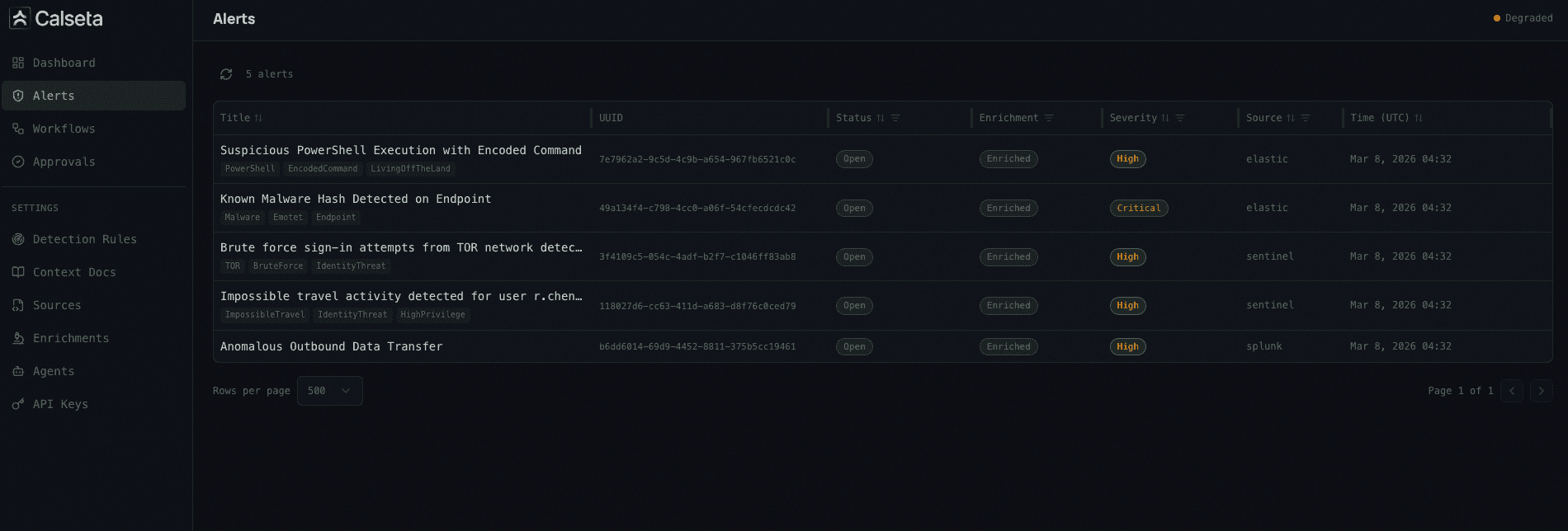
A clean, purpose-built interface for managing alerts, enrichment, workflows, and context — designed to be read by both humans and agents.
One command.
Fully running.
Single Docker Compose command. Point your SIEM at the ingest endpoint. Register your first agent webhook. Done.
Your security agent receives a fully enriched, agent-ready alert payload with detection rule documentation, applicable runbooks, and available workflows — in under 60 seconds from alert trigger.
# Clone and start
git clone github.com/calseta/calseta
cd calseta && cp .env.example .env
docker compose up
✓ PostgreSQL ready
✓ Migrations applied
✓ FastAPI running on :8000
✓ MCP server running on :8001

# Create your first API key (admin bootstrap)
curl -X POST localhost:8000/v1/api-keys \
  -d '{"name": "my-agent"}'
→ cai_a3f8x... (save this)

# Register your agent webhook
curl -X POST localhost:8000/v1/agents \
  -H "Authorization: Bearer cai_a3f8x..." \
  -d '{
    "name": "My Investigation Agent",
    "endpoint_url": "https://my-agent/webhook",
    "trigger_on_severities": ["High","Critical"]
  }'
→ agent registered ✓
92% fewer tokens. Comparable quality. Safer outcomes.
We ran the same 5 alert scenarios through GPT-4o and Claude Sonnet — with and without Calseta. The difference is measurable.
Assumptions: engineering cost based on configurable hourly rate above (default $150/hr), 17.5 hrs per provider for custom integration vs 0.5 hrs with Calseta. Token estimates derived from observed benchmark data. See full methodology in the case study.
One alert. Zero tokens wasted.
That's what your agents deserve.
From raw webhook to closed investigation. Calseta handles the deterministic infrastructure. Your agents handle the reasoning.
Open source · Self-hostable · Apache 2.0